
Table of Contents
- Why Most NC Homeowners Only Think About Shingles When Evaluating a Roof Quote
- Why the Components Under the Shingles Matter as Much as the Shingles Themselves
- The Complete GAF Roofing System: Every Component Explained
- How Complete System Components Connect to GAF Warranty Tiers
- Complete vs Incomplete GAF System Installation: What to Look for in a Quote
- NC Climate-Specific Component Importance
- How to Verify Your Contractor Is Installing the Complete GAF System
- How Oak Tree Roofing Approaches GAF System Installation
- Want to Confirm Your NC Roof Replacement Includes a Complete GAF System?
- Frequently Asked Questions About GAF Roofing System Components
- Get a Complete GAF System Installation From Oak Tree Roofing in NC
Three roofing quotes are sitting on your kitchen table. All three mention GAF shingles. The prices are $4,200 apart between the lowest and highest. You are trying to figure out why.
The answer is almost certainly not the shingles. Premium GAF shingles cost within a few hundred dollars across installers for the same square footage. The $4,200 difference is what is under and around the shingles. The components that will be invisible once the roof is complete but that determine whether the roof performs for 15 years or 30, whether the GAF warranty covers workmanship as well as products, and whether you have a complete roofing system or a surface-level application.
This guide explains what each component of a complete GAF roofing system is, what it does, and how to tell from a quote whether your contractor is installing the whole system.
For a complete GAF system installation consultation, call Oak Tree Roofing at +1 910-510-4659.
Why Most NC Homeowners Only Think About Shingles When Evaluating a Roof Quote
The Visibility Problem That Makes Shingles the Default Focus
Shingles are what you see every day from your driveway and what visitors see from the street. When a roof replacement is discussed, the shingle brand and color are what homeowners naturally focus on because they are the visible, tangible element of the investment.
The components installed under the shingles are invisible the moment the last course of shingles is nailed. You will never see your leak barrier, your underlayment, or your starter strip after installation day. This invisibility is exactly why some contractors substitute cheaper alternatives or skip components entirely: the homeowner cannot easily tell the difference after the job is done.
What Incomplete GAF System Installation Actually Means for NC Homeowners
An incomplete GAF system installation looks identical to a complete one from the street. The shingles are the same. The curb appeal is the same. What is different is performance under weather stress, long-term durability, and warranty eligibility.
A roof that uses GAF shingles over a non-qualifying underlayment from a different manufacturer is not a GAF system. It is GAF shingles on a partial system that may not be eligible for the warranty tier the homeowner was told they would receive.
Why the Components Under the Shingles Matter as Much as the Shingles Themselves
A GAF shingle is the outermost layer of a multi-layer roofing system. Each layer beneath the shingle performs a specific protective function that the shingle alone cannot provide. The deck protection prevents moisture from reaching the structural roof deck. The leak barrier protects the most vulnerable penetration points. The starter strip creates the adhesive bond at the roof’s edge. The ventilation system manages heat and moisture under the entire roof. When any layer is compromised or absent, the shingles above it cannot compensate.
Why Premium Shingles on a Compromised System Underperform
A GAF Timberline HDZ shingle installed over a compromised or absent underlayment is exposed to conditions at the deck level that the shingle’s surface performance ratings do not account for. Shingle wind and impact ratings assume a properly prepared substrate. Without proper deck protection, the shingle installation is working against conditions below that the product specification never anticipated.
The same principle applies to every component. Each layer performs its specific function. The absence or substitution of any layer affects the performance of every layer above it.
The Complete GAF Roofing System: Every Component Explained
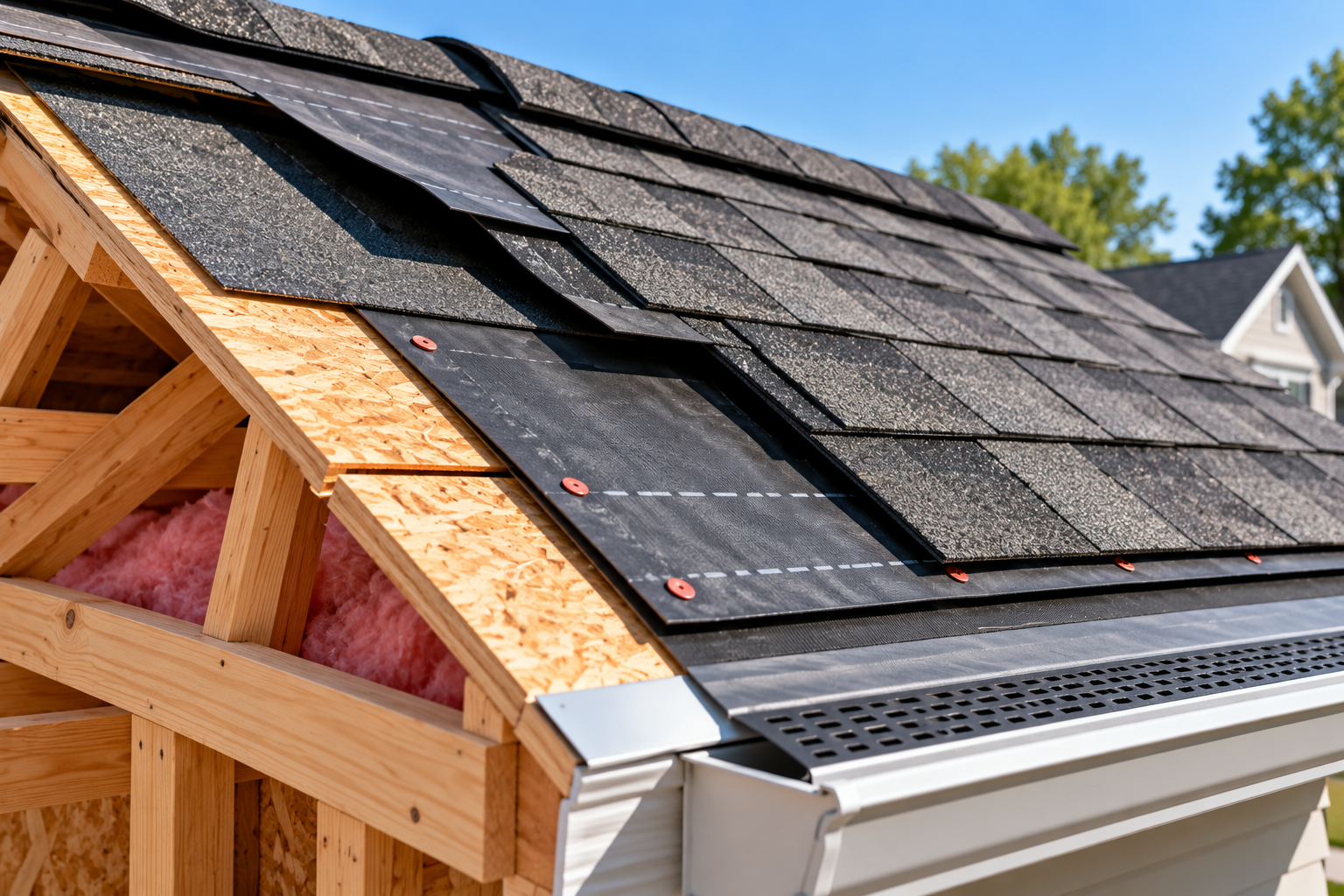
A complete GAF roofing system consists of six components: deck protection (underlayment that covers the entire roof surface), a leak barrier (self-adhering ice and water protection at vulnerable areas), starter strip shingles (the first course along eaves and rakes), the shingles themselves (the visible surface layer), ridge cap shingles (the finished cap at the roof peak), and attic ventilation (the intake and exhaust system that manages heat and moisture under the roof). Each component has a specific function and each must be installed correctly for the system to perform as designed.
Component 1: Roof Deck Protection (Underlayment)
What it is: A layer of synthetic or felt material installed directly over the roof deck before any shingles are applied. It covers the entire roof surface.
What it does: The deck protection layer is the secondary water barrier that protects the structural roof deck if any shingles are damaged, lifted by wind, or fail to shed water completely. In heavy rain with wind-driven water, water that gets under a shingle finds the underlayment rather than the wood deck.
Why it matters in NC: NC’s hurricane fringe zone and frequent severe thunderstorms produce wind-driven rain that tests the secondary water barrier regularly. A quality GAF synthetic underlayment outperforms felt alternatives in these conditions with better tear resistance and moisture management.
GAF products: GAF FeltBuster, GAF Deck-Armor, GAF Tiger Paw.
Component 2: GAF Leak Barrier (Ice and Water Shield)
What it is: A self-adhering waterproof membrane applied at the most vulnerable roof areas: eaves, valleys, around chimneys, skylights, and other penetrations.
What it does: The leak barrier creates a watertight seal at the areas where water is most likely to penetrate due to pooling, ice damming, or wind-driven rain intrusion. Unlike standard underlayment which sheds water, the leak barrier adheres to the deck and seals around fasteners to prevent water from entering at nail penetration points.
Why it matters in NC: NC does not see significant ice dam formation in most areas but does experience wind-driven rain at valleys and eave areas during tropical system impacts. The leak barrier is the protection layer for these high-risk areas.
GAF products: GAF WeatherWatch, GAF StormGuard.
Component 3: GAF Starter Strip Shingles
What it is: A specially designed first course of material installed along the eave and rake edges before the field shingles are applied.
What it does: The starter strip provides the adhesive base that bonds the first course of field shingles securely at the roof’s most wind-vulnerable edges. Without a properly installed starter strip, the first course of shingles has no adhesive sealant underneath and is significantly more vulnerable to wind lift.
Why it matters in NC: The eave and rake edges are where wind lift begins. NC’s frequent severe thunderstorms and occasional tropical system winds make the starter strip’s adhesive bond critically important for the first course’s integrity.
GAF products: GAF ProStart, GAF WeatherBlocker.
Component 4: GAF Shingles (The Surface Layer)
What it is: The visible asphalt composite shingles that cover the field of the roof.
What it does: The shingle layer sheds precipitation, provides UV protection to the layers beneath, provides wind resistance across the roof field, and delivers the aesthetic appearance of the finished roof. The shingle is the most engineered component in the system and the one most directly connected to warranty tier and performance rating.
GAF products: GAF Timberline HDZ, GAF Timberline CS, GAF Timbersteel, and other GAF residential shingle lines.
Component 5: GAF Ridge Cap Shingles
What it is: Purpose-built shingles designed specifically for the ridge (peak) of the roof where two slopes meet.
What it does: The ridge cap finishes the highest and most visible line of the roof while providing sealed protection at the peak where two slopes meet. Standard field shingles cut and bent at the ridge do not seal properly and are not rated for ridge application. GAF ridge cap shingles are engineered for the specific stress and weather exposure at the roof peak.
Why it matters: A ridge that is capped with cut field shingles rather than purpose-built ridge cap shingles is an installation shortcut that compromises both the appearance and the protection of the most exposed point on the roof.
GAF products: GAF Seal-A-Ridge, GAF TimberTex.
Component 6: Attic Ventilation
What it is: The intake and exhaust ventilation system that allows air to flow through the attic space. Intake vents are typically at the eaves (soffit vents). Exhaust vents are at or near the ridge.
What it does: Proper ventilation manages heat and moisture accumulation under the roof. Without adequate ventilation, summer heat builds to temperatures that degrade shingle adhesive and shorten shingle lifespan. Moisture accumulation without ventilation creates the conditions for mold growth, deck rot, and insulation damage.
Why it matters for GAF warranty: GAF’s warranty requires that ventilation meets GAF’s standards at installation. Improper ventilation discovered during a warranty claim investigation can void coverage.
GAF Roofing System Component Quick Reference Table
| Component | Location | Primary Function | NC-Specific Importance |
| Deck protection | Full roof surface | Secondary water barrier | Wind-driven rain protection |
| Leak barrier | Vulnerable areas | Watertight seal at penetrations | Hurricane fringe zone protection |
| Starter strip | Eave and rake edges | Adhesive bond for first course | Wind lift prevention |
| Shingles | Full roof field | Primary water shedding and UV protection | Impact and wind rating |
| Ridge cap | Roof peak | Sealed peak finish | Highest exposure point protection |
| Attic ventilation | Soffit and ridge | Heat and moisture management | NC humidity and heat management |
How Complete System Components Connect to GAF Warranty Tiers
GAF’s enhanced warranty tiers including System Plus, Silver Pledge, and Golden Pledge require that qualifying GAF-branded components be installed as part of the system. Using non-qualifying components in place of GAF-branded products at any system layer may reduce the homeowner’s warranty eligibility from the enhanced tier to the Standard Limited Warranty, which provides significantly less coverage. The specific components required for each warranty tier are verified by GAF at registration.
Which Components Must Be GAF-Branded for Warranty Eligibility
GAF’s System Plus and higher warranty tiers require installation of qualifying GAF products in specific component categories. The exact qualifying products are published by GAF and verified at warranty registration. At minimum, the shingles, deck protection, leak barrier, starter strip, ridge cap, and ventilation components typically must meet GAF’s qualifying specifications.
A contractor who uses a competing brand’s underlayment under GAF shingles and registers the installation for a System Plus warranty may find that the registration is rejected or that the warranty is issued at the Standard tier rather than the enhanced tier because the component specifications were not met.
What a Homeowner Loses When Non-Qualifying Components Are Substituted
The difference between a Standard Limited Warranty and a System Plus warranty is not cosmetic. System Plus adds contractor-backed workmanship coverage that the Standard warranty entirely lacks and extends the non-prorated product coverage period. A homeowner who was quoted System Plus coverage but received Standard coverage because their contractor substituted non-qualifying components has a significantly less protected investment than they believed when they signed the contract.
For the complete explanation of how each GAF warranty tier differs and what the workmanship coverage addition means financially, our guide on GAF roof warranties compared Standard System Plus Silver Pledge and Golden Pledge covers every tier in full detail.
Complete vs Incomplete GAF System Installation: What to Look for in a Quote
A complete GAF system installation quote itemizes every component by specific product name, not just “underlayment” or “starter strip.” A quote that says “GAF Timberline HDZ shingles” without naming the specific deck protection product, leak barrier product, starter strip product, and ridge cap product is not a documented complete system quote. The absence of specific product names for each component is the most reliable indicator that the quote may not include qualifying GAF products in every layer.
What a Complete GAF System Quote Should Itemize
A complete and transparent GAF system quote should include specific product identification for:
- Deck protection: Product name and specification (example: GAF Deck-Armor synthetic underlayment)
- Leak barrier: Product name and coverage areas (example: GAF WeatherWatch at all eaves, valleys, and penetrations)
- Starter strip: Product name (example: GAF ProStart)
- Shingles: Product name, style, and color (example: GAF Timberline HDZ in Pewter Gray)
- Ridge cap: Product name (example: GAF TimberTex)
- Ventilation: Intake and exhaust specification
Complete vs Incomplete Quote Comparison Table
| Quote Element | Complete System Quote | Partial or Shingles-Only Quote |
| Deck protection | Named GAF product with specification | “Felt” or “underlayment” without brand |
| Leak barrier | Named GAF product with coverage areas | Not mentioned or “ice and water” without brand |
| Starter strip | Named GAF product | Not mentioned or “starter shingles” |
| Shingles | Named GAF product with style and color | Named GAF shingle product |
| Ridge cap | Named GAF product | “Ridge cap” without brand or not specified |
| Ventilation | Intake and exhaust specification | Not mentioned or “existing ventilation” |
NC Climate-Specific Component Importance
Why Leak Barrier Matters in NC’s Hurricane Season Fringe Zone
Fayetteville and Cumberland County sit within the fringe zone of Atlantic hurricane impacts. Tropical systems that track inland across NC lose significant intensity but can still produce sustained winds of 40 to 60 mph with gusts higher alongside heavy rain. At these wind speeds, water is driven horizontally under shingles at valley areas and eave edges where the leak barrier is the last line of defense before the deck.
Why Proper Ventilation Is Critical in NC’s Humid Summer Climate
NC summers produce ambient humidity levels that create significant moisture accumulation in inadequately ventilated attic spaces. Without proper intake and exhaust airflow, this moisture condenses on the underside of the roof deck, promoting biological growth, deck degradation, and insulation damage. NC’s summer heat also builds attic temperatures that can reach 150 degrees Fahrenheit without ventilation, temperatures that degrade shingle adhesive and accelerate granule loss.
How NC’s Heat and Humidity Affect Underlayment Performance Requirements
Synthetic GAF underlayment products outperform felt alternatives in NC’s conditions because synthetic materials do not absorb and release moisture the way felt does. In NC’s humid environment, felt underlayment that gets wet during a rain event in the installation window can wrinkle and buckle as it dries, affecting the shingle surface installed over it. GAF synthetic deck protection products manage these conditions without the moisture absorption issue.
How to Verify Your Contractor Is Installing the Complete GAF System
Requesting the Material List Before Signing the Contract
Ask any roofing contractor to provide a specific material list by product name before signing the contract. If they cannot or will not provide specific GAF product names for every system component, ask why. A legitimate GAF certified contractor installing a complete system should be able to provide this list without hesitation.
Verifying GAF Product Codes and Labels During Installation
On installation day, GAF products arrive in branded packaging with product names and codes visible on the wrapping. If you are present during installation, you can verify that the products being installed match the contract specifications. Ask to see the packaging for the underlayment and leak barrier specifically, as these are the most commonly substituted components.
What Oak Tree Roofing Provides as Documentation at Project Completion
Oak Tree Roofing provides a complete project documentation package at project completion that includes the specific GAF products installed by component, the warranty registration confirmation from GAF, and the certification documentation for the installing contractor. This documentation is what the homeowner needs for any future warranty claim and for disclosure at property sale.
How Oak Tree Roofing Approaches GAF System Installation
Our Complete System Installation Standard for Every NC Project
Oak Tree Roofing installs the complete GAF roofing system on every qualifying project. Every component is a GAF qualifying product. No substitutions for non-qualifying alternatives. The complete system is what the homeowner was quoted, and the complete system is what goes on the roof.
The GAF Components We Include in Every Oak Tree Roofing Installation
Every Oak Tree Roofing GAF system installation includes qualifying GAF deck protection, GAF leak barrier at all required areas, GAF starter strip at eaves and rakes, the quoted GAF shingle product, GAF ridge cap at all ridges and hips, and ventilation that meets GAF’s warranty requirements for the specific attic configuration.
For the complete explanation of what GAF certification means for the products and warranty tiers available from Oak Tree Roofing, our guide on GAF certified vs Master Elite what each tier actually unlocks covers our certification status and what it enables for NC homeowners.
Want to Confirm Your NC Roof Replacement Includes a Complete GAF System?
Call +1 910-510-4659, find us on Google Maps, or visit our contact page to discuss your specific NC roof replacement and confirm what system components are included in any quote you have received.
Frequently Asked Questions About GAF Roofing System Components
What components make up a complete GAF roofing system?
A complete GAF roofing system includes six components: deck protection (underlayment covering the entire roof surface), a GAF leak barrier at eaves, valleys, and penetrations, GAF starter strip shingles at eave and rake edges, GAF field shingles as the surface layer, GAF ridge cap shingles at the roof peak, and attic ventilation meeting GAF’s specifications. All six components must be present for the installation to qualify as a complete GAF roofing system.
How do GAF roofing system components affect the warranty?
GAF’s enhanced warranty tiers including System Plus, Silver Pledge, and Golden Pledge require that qualifying GAF-branded components be installed in each system layer. Using non-qualifying products in any component layer may reduce warranty eligibility from the enhanced tier to the Standard Limited Warranty, which lacks workmanship coverage and has a shorter non-prorated coverage period.
What should a complete GAF roof replacement quote include?
A complete GAF roof replacement quote should itemize every component by specific GAF product name including the deck protection product, leak barrier product and coverage areas, starter strip product, shingle product with style and color, ridge cap product, and ventilation specification. A quote that names only the shingle product without specifying the other components by name is not a documented complete system quote.
Why does attic ventilation matter for a GAF roofing system in NC?
NC’s humid summers create attic moisture accumulation and heat buildup that proper ventilation manages. Without adequate intake and exhaust airflow, attic temperatures can reach 150 degrees damaging shingle adhesive, and moisture accumulation promotes deck degradation. GAF’s warranty also requires that ventilation meets GAF’s standards at installation, meaning improper ventilation can affect warranty eligibility.
How can I tell if my contractor is installing a complete GAF system?
Request a specific product list by component name before signing the contract. On installation day, ask to see the packaging for the underlayment and leak barrier, as these are the most commonly substituted components. At project completion, request documentation showing the specific GAF products installed by component. A GAF certified contractor installing a complete system should provide all three without hesitation.
Get a Complete GAF System Installation From Oak Tree Roofing in NC
Every component is named. Every layer is explained. The warranty connection is clear. The quote evaluation tool is in your hands.
Oak Tree Roofing installs complete GAF roofing systems across Fayetteville, Hope Mills, Raeford, Lumberton, Spring Lake, Sanford, Southern Pines, Pinehurst, and surrounding NC communities with every component specified, every product qualifying, and every installation documented.
Call +1 910-510-4659, find us on Google Maps, or visit our services page to discuss your NC roof replacement.
For the complete picture of how GAF contractor certification determines which warranty tiers are available from your installing contractor, our guide on does GAF certification actually matter or is it just a logo on a truck covers the certification and consumer protection connection in full.
The components under your shingles are invisible once the job is done. Make sure you know what is there before the first nail goes in.